
Recent experiences in writing things down and making stuff
Is it possible to learn something about what kind of world is possible here on Earth, while in the process of building a world as a setting for our stories?
I have been thinking about what it means to me to make up a fantasy world, and why it’s so hard and requires so much time and brain power. It’s easy to get bogged down obsessing about the little details and to sort of forget to think about the stories. But at the same time, the world’s stories’ unfolding are the world, if that makes sense. They’re inextricable, the world and the stories! Right?
One difficulty for me is contained in what I want for this world I’m creating and how that relates to our own world and our own trajectories. I would like Foervane to be different from our world while also recognizably a human, or human-like, environment. I would like its people to have chosen different paths and chosen more intelligently than “we” have – to have not chosen their own destruction. But at the same time, I hope that it’s not serving as just an opportunity for me to escape. I don’t think escapism is the point of fantasy, at least not the way I’d like to write it. I would like to be able to imagine the world in a radical way, not just as if I had traced over the main lines of our world and changed the names and added some fantasy creatures and magic. Is that too much to ask?
Of course, I would like the world to be dynamic and evolving. Some of its people will be going through turbulent and destructive times, sometimes of their own making. But I would like those destructive times to be useful to the people in that they design their futures with more thoughtfulness and care..? Is that naive?
Anyway, I’ve made a lot of notes in a notebook about other people’s ways of building worlds and the stories that unfold within them. One area of focus is the way some fantasy or sci-fi authors have explored women’s power, sexism, and misogyny in their worlds and how the balance of power has shifted over time.
Earlier this year I finished reading Tehanu, the fourth book in the Earthsea Cycle by Ursula K Le Guin. A recurring character of the series is a main character in this book. Her name is Tenar and she takes in a small girl who has been abused and badly burned (on purpose) by her relatives. A couple of scenes from the book were particularly interesting to me in terms of what I’m thinking about for my world and the world I’m trying to create. One is an interaction with the young girl she has adopted, Therru, who has asked Tenar to tell her “the story about the cat ghosts.”
“That’s a summer story,” Tenar replies, and when Therru looks at her askance, she explains to the child that winter is the time for the great stories, creation stories, and about the songs of heroic deeds. Then once winter has gone, they can sing the songs that they learned in the winter.
“”I can’t sing,” the girl whispered.
…
“Not only the voice sings,” [Tenar] said. “The mind sings. The prettiest voice in the world is no good if the mind doesn’t know the songs.””
In the world of Earthsea, Tenar has lived all her life with certain ideologies, just as we all have in our world. Because of this, it takes time and experience and thought and discussion to realize what she must do in her role in Therru’s life. Some part of her effort to figure out who Therru is and who she can be, are obscured even to her as she walks this foggy path toward understanding. She has recognized that Therru has power, but she doubts her own ability to guide the child; Earthsea norms dictate strict gender roles, especially related to those who have magical abilities. Yet Tenar has already imparted wisdom to Therru.
This reminds me of that Le Guin quote that gets passed around a lot, about how we used to accept the divine right of kings, and that tells us that we won’t always accept that capitalism is the only possible system.
The other scene is between Tenar and her longtime friend, Ged, an Archmage of Earthsea. They are discussing the roles of women and Ged automatically repeats the ideology that he has been steeped in over the course of his life. He says that if a woman were to become Archmage then she would “unmake what she became in becoming it… If women had power, what would men be but women who can’t bear children? And what would women be but men who can?”
Tenar and Ged go on to discuss women’s power: what is it? Ged says that queens only have power because men give it to them, so, what is women’s power? Is it in the home, as Ged suggests? Tenar argues that if it’s in the home then why are all the doors locked; why do women have to be protected? Ged says, in a moment of realization, it’s because of men’s fear, “If your strength is the other’s weakness, then you live in fear.”
Tenar: “Yes; but women seem to fear their own strength, to be afraid of themselves.”
Ged: “Are they ever taught to trust themselves?”
I like how this is being parsed out in the book; I like the building of thought upon thought, the back and forth. We on Earth are still working this out too. The foundation of women’s power can’t be shifted suddenly because of a few powerful women. Another thing I noticed and appreciated was that I, as the reader, don’t get easy answers from the series. No superhero-style kickass woman swings in and solves the misogyny and sexism; instead it unravels slowly and frustratingly, just as it does in our world. It gets worse before it gets better and then it gets worse again, but maybe this time “worse” is a little bit less worse.
“No,” says Tenar. “Trust is not what we’re taught… If power were trust. I like that word. If it weren’t all these arrangements – one above the other – kings and masters and mages and owners,; it all seems so unnecessary. Real power, real freedom, would be in trust not force.”
I like thinking about all of this and it makes me glad that I persisted with reading Earthsea despite finding some of the earlier stories and themes frustrating at times. Le Guin herself said that she learned a lot and changed much of her thinking over the long process of writing the books. As I read the earlier books, I found myself kind of hoping for something to contradict the “weak as women’s nagic” part rather being patient and allowing the process to unfold. But as I said, real change doesn’t happen like that.
All of this is to say that reading Earthsea and then listening to and reading Le Guin’s comments and thoughts about how changes and shifts in power may happen, are helping me to think about my own fantasy world and the stories within it, (I hope) in a more radical way so I don’t just fall back on the same old systems and patterns that we humans have followed. I know this is probably quite convoluted, but you should see the inside of my head, is all I can say.
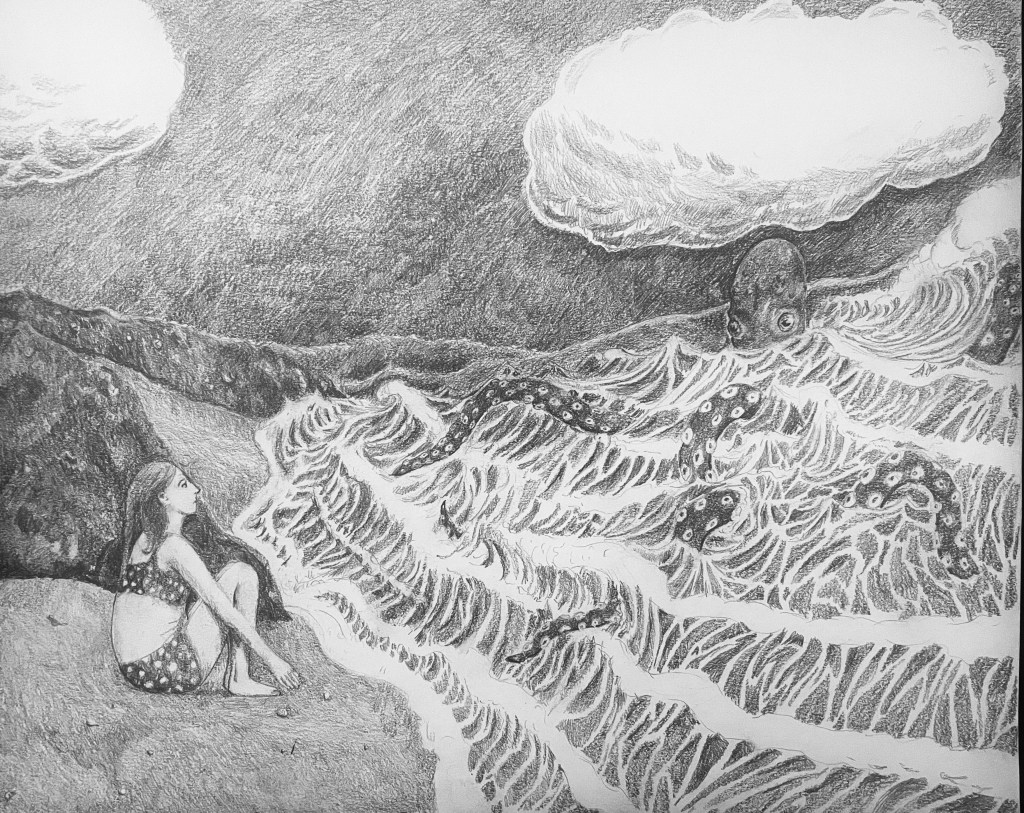
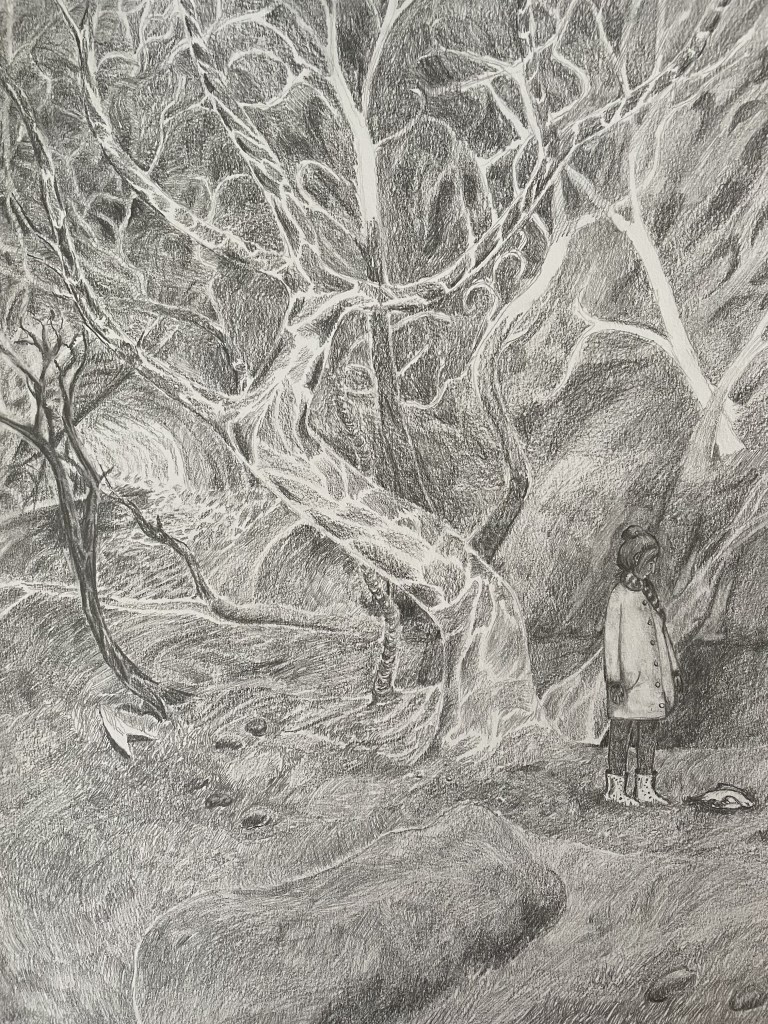
In addition to this, I have been drawing a bit, with mechanical pencils, just to see what comes out. I’ve shared two of these drawings here.
 paper-crow-press.com